
When Canadians, and many people around the world, think of Canada, one of the things that comes to mind is maple syrup. Modern Canadians think it is such a uniquely Canadian thing and that it’s always been that way. The truth is, that is a modern myth. For most of the 530+ years that Europeans have been around North America, it has been places south of the border that produced more of the product than all of Canada did.
Maple syrup comes to us by concentrating the sap that flows in maple trees in the spring. It takes certain climatic conditions to enhance that. Northeastern North America is uniquely situated to benefit from that. Europeans learned about this from indigenous peoples, of course, but European metallurgy allowed for the optimization of the process of making syrup and sugar. Early on, it was the sugar that producers were after and is why the practice is called maple sugaring, not maple syruping.
When British taxes taxed cane sugar from the British Caribbean, New Englanders and others in the northeast were able to escape these taxes by making their own sugar. This was particularly true after the Revolutionary War when trade was affected. Founding Fathers such as Thomas Jefferson considered ways for Americans to become independent from British goods such as sugar. They looked at sources such as maple sugar to fill that need. To this end, he planted several maple trees from Vermont at Monticello as an experiment. Canadians were not affected by that lack of trade and thus had no need to develop their own sources.
The 1800s saw many improvements in maple syrup production, mostly by U.S. producers and companies who produced better and more efficient evaporators. The produced more maple syrup/sugar than they did for most of the 20th century.
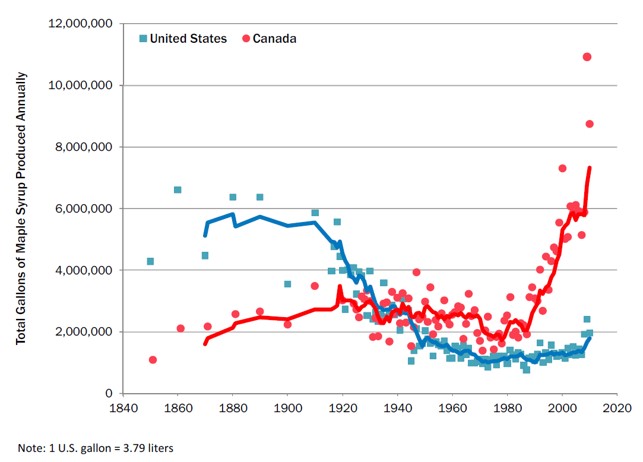
This is not to say that maple syrup production did not happen in Canada as it surely did. Maple syrup has always been around in both countries. It’s just a fact the U.S. produced and used more of it until the 1950s. Then for about 30 years, both countries produced about the same amount. It wasn’t until the development, and widespread adoption of tubing and other technologies that it became possible for Canada to start producing more maple syrup than the U.S.
The problem was, how to make it economical. Quebec realized that it had an enormous potential on it’s hand but needed a way to capitalize on it. They followed the lead of OPEC and decided to corner the market of supply. That would drive prices up. They also needed a way to stabilize the market supply to keep prices consistently high. And so they created what is basically a maple syrup cartel. The forced every producer in the Province to join. They would collect maple syrup into what the called a reserve, blend it and then sell it. This gave them the way to control the supply. A lot of people hear “maple syrup reserve” and think that it’s to make sure that Canadians had an adequate supply. However, it’s more about economics than the product.
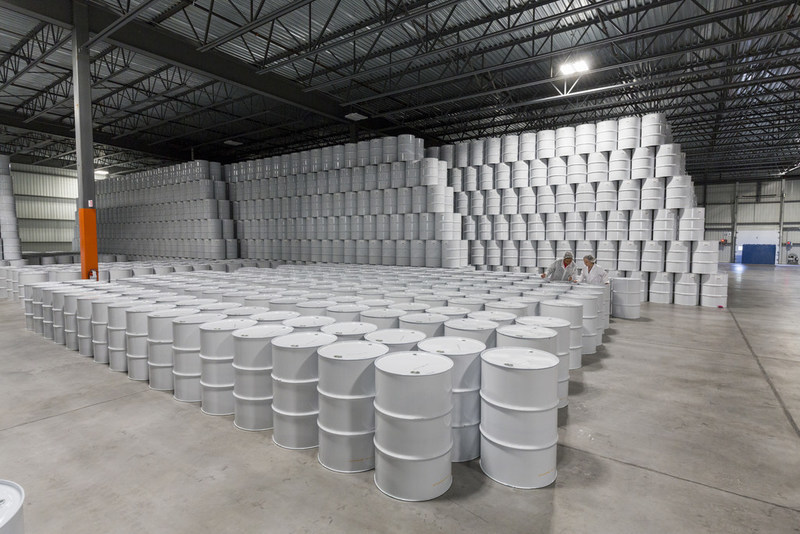
They then went to work giving huge incentives for producers to make more syrup. As they did, Quebec (and Canada by extension) produced a larger and larger percentage of the worlds maple syrup supply. By controlling releases from the reserve, they artificially made the supply look smaller than it was. It also increased the value of the product they had in reserve.
It was during this time that the myth of maple syrup being essential to Canadian identity was really born. Prior to that, maple syrup was just another product of Canadian agriculture similar to Canadian Whisky or lumber products. However, it began to take a life of it’s own through marketing and growth in the sector. Today, Canadians think that everything from the maple leaf on the Canadian flag is a result of maple syrup having been so important to Canadians throughout their history. The problem is, early on it wouldn’t have been about syrup and for most of it’s history it wasn’t important enough to make until more recently. That makes it a lie that many people believe but simply is not true.